

MLM Legal Compliance in India: Complete Guide for Direct Selling Companies
Introduction
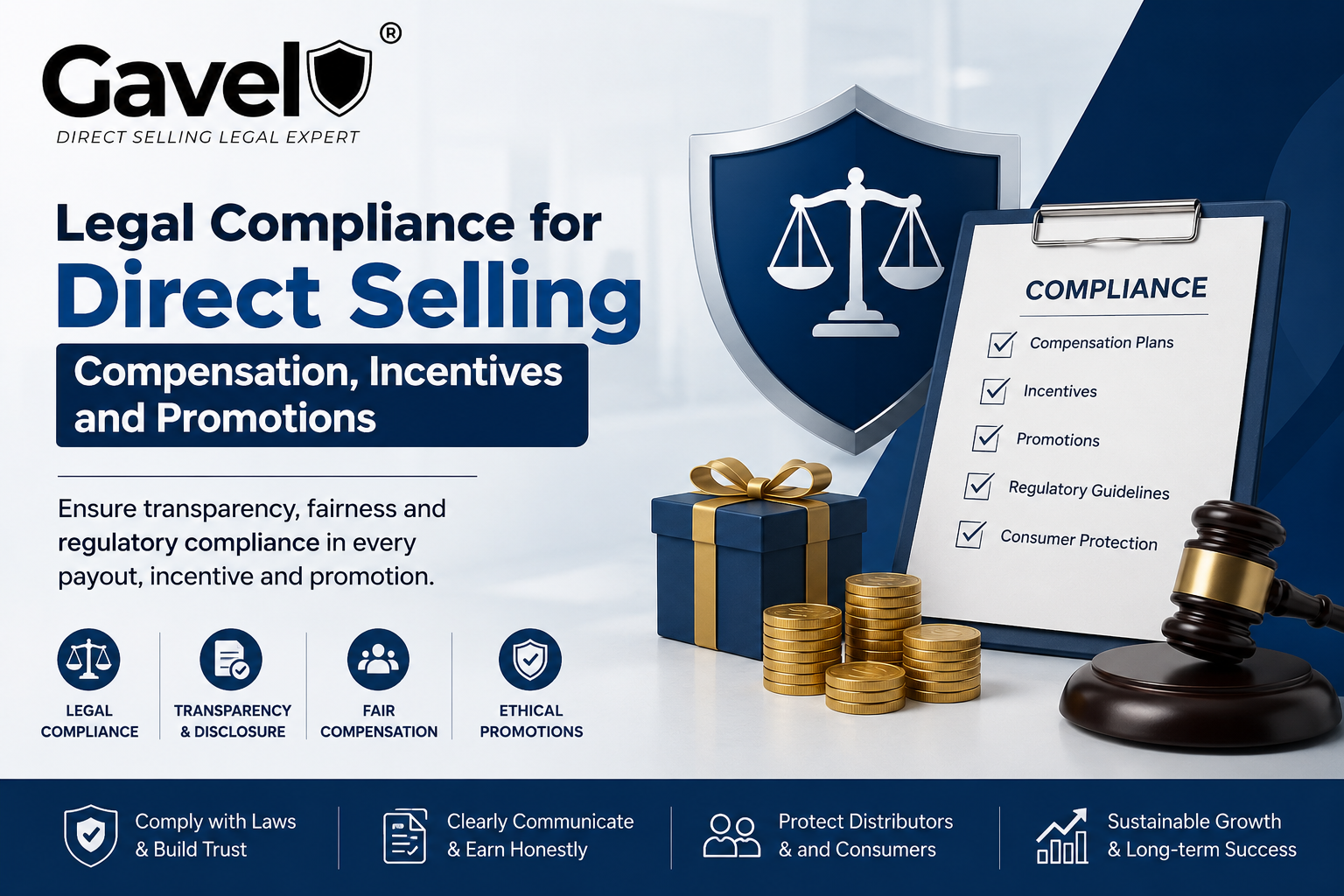
Compensation plans, incentives, bonuses, contests, and promotional schemes are important tools for growing a direct selling business. However, these programs must be carefully structured to comply with applicable Indian laws and regulations.
A legally compliant compensation system should reward genuine sales of products or services rather than primarily encouraging recruitment. Similarly, promotional campaigns must be transparent, truthful, and supported by appropriate terms and conditions.
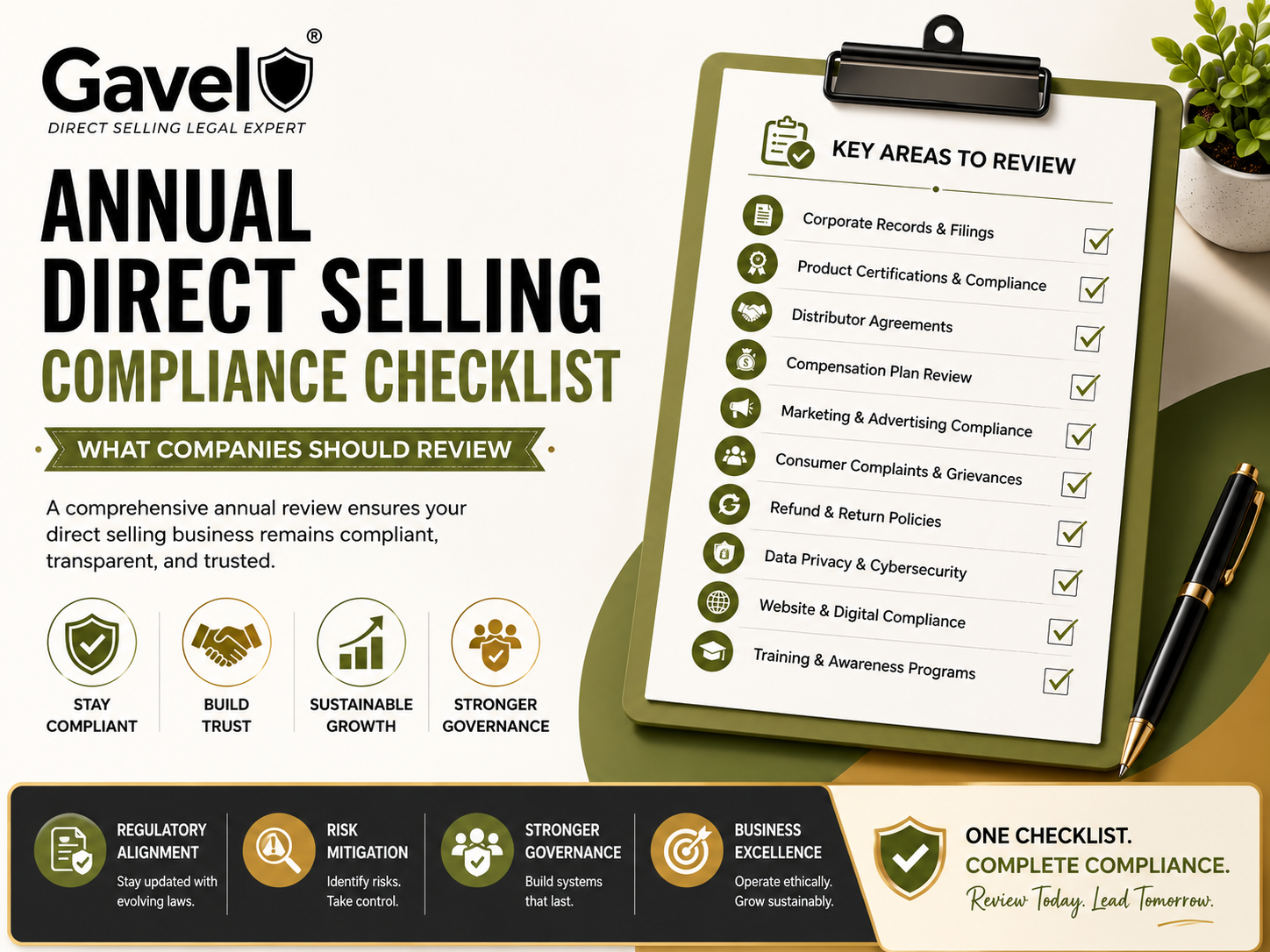
For direct selling entities, compliance is not limited to the design of the compensation plan. Companies should also review distributor agreements, incentive eligibility, earnings communications, promotional claims, refund policies, records, and customer disclosures.
1. Ensure Compensation Is Based on Genuine Product or Service Sales
A compensation plan should have a clear connection with the sale of genuine products or services to consumers.
Companies should avoid structures where distributors can earn significant rewards merely by:
- Recruiting new participants
- Paying joining or participation fees
- Purchasing products primarily to qualify for commissions
- Making investments or deposits
- Bringing in additional distributors without corresponding genuine sales
The compensation structure should demonstrate that income is generated from legitimate business activity and product sales.
2. Avoid Recruitment-Driven Compensation Structures
One of the major legal risks in direct selling is creating a compensation model that resembles a pyramid scheme.
A compliant plan should not make recruitment the primary source of financial benefit. Incentives should instead be connected to measurable business performance, such as eligible product or service sales.
Companies should periodically review:
- Recruitment commissions
- Team bonuses
- Rank incentives
- Leadership bonuses
- Qualification requirements
- Minimum purchase requirements
- Sales-volume calculations
- Downline-related incentives
The objective should be to ensure that the overall structure does not create an unlawful recruitment-focused model.
3. Clearly Define Commissions, Bonuses and Incentives
Every compensation component should be clearly documented.
The compensation plan should explain:
- Who is eligible
- How commissions are calculated
- Qualification criteria
- Sales-volume requirements
- Payment schedules
- Applicable deductions
- Conditions for earning incentives
- Circumstances in which incentives may be withheld or reversed
- Rules for returns, cancellations and chargebacks
Ambiguous compensation terms can result in distributor disputes and regulatory concerns.
4. Be Transparent About Income Opportunities
Income-related communications should not create unrealistic expectations.
Companies and distributors should avoid statements suggesting that participants can easily become wealthy, earn guaranteed income, replace their salary quickly, or achieve financial independence without substantial effort.
Earnings examples should be:
- Accurate
- Verifiable
- Based on appropriate data
- Accompanied by necessary disclosures
- Representative of actual results where applicable
Testimonials and success stories should not be presented in a way that creates misleading expectations about typical earnings.
5. Design Incentives Around Legitimate Performance
Incentive programs such as travel rewards, recognition programs, gifts, bonuses, and leadership awards can be useful when properly structured.
Before launching an incentive, companies should establish written eligibility criteria covering:
- Qualifying sales
- Performance periods
- Distributor eligibility
- Product categories included
- Return and cancellation treatment
- Disqualification conditions
- Tax treatment, where applicable
- Verification and audit procedures
This helps ensure that incentives are administered consistently and transparently.
6. Review Promotional Schemes Carefully
Promotional offers may include discounts, cashback, gifts, contests, limited-period offers, referral programs, coupons, and special product bundles.
Promotional materials should clearly communicate important conditions, including:
- Offer validity
- Eligibility
- Product or service coverage
- Quantity restrictions
- Redemption requirements
- Exclusions
- Refund and cancellation conditions
- Applicable terms and conditions
Promotions should not contain misleading representations about price, savings, product benefits, scarcity, or availability.
7. Control Distributor Marketing and Advertising
Direct selling companies should establish clear marketing guidelines for distributors.
Distributors should be prohibited from making unauthorized claims regarding:
- Product performance
- Health or wellness benefits
- Guaranteed results
- Income opportunities
- Investment returns
- Company approvals or certifications
- Government endorsement
Companies should maintain a monitoring mechanism for distributor-generated social media posts, advertisements, videos, websites, brochures, and other promotional content.
8. Maintain Proper Product and Certification Compliance
Compensation and promotional compliance should be considered together with product compliance.
Depending on the nature of the product, businesses may need to review applicable requirements relating to labeling, quality standards, safety, licenses, registrations, certifications, weights and measures, consumer disclosures, and sector-specific regulations.
A promotional campaign should never imply that a product has a certification, approval, endorsement, or regulatory status that it does not actually possess.
9. Document the Compensation Plan and Promotional Rules
A strong compliance framework should maintain written records of:
- Current compensation plans
- Historical compensation plans
- Incentive policies
- Promotional terms and conditions
- Distributor agreements
- Commission calculations
- Sales records
- Customer transactions
- Refunds and returns
- Distributor communications
- Marketing approvals
- Complaints and resolutions
Good documentation can help demonstrate that the company's practices are transparent and consistently administered.
10. Establish a Compliance Review Process
Before launching a new compensation plan, incentive, contest, or promotional campaign, the company should conduct a legal and compliance review.
A practical review can include:
Step 1: Identify the business objective.
Step 2: Define the qualifying sales or performance criteria.
Step 3: Review the compensation or promotional mechanics.
Step 4: Check for recruitment-focused or misleading elements.
Step 5: Review advertising and earnings claims.
Step 6: Verify applicable product, consumer, tax, and sector-specific requirements.
Step 7: Approve the final terms and distributor communication.
Step 8: Monitor implementation and complaints.
READ MORE-https://gavellawfirm.in/blog/direct-selling-policy-drafting
Key Compliance Takeaway
A successful direct selling compensation plan should reward genuine sales and legitimate performance while avoiding recruitment-driven financial incentives. Incentive programs and promotions should be transparent, documented, and supported by clear eligibility requirements and accurate marketing communications.
Because the applicable legal requirements can vary depending on the company's products, business model, advertising practices, and operational structure, businesses should obtain a legal review before implementing or materially changing their compensation or promotional programs.


.png)