

Direct Selling Company Registration in India Complete Legal & Compliance Guide
MLM Legal Compliance in India: Complete Guide for Direct Selling Companies
MLM and direct selling businesses in India operate in a regulated environment where legal compliance is essential for sustainable growth. Compliance is not limited to forming a company or preparing a distributor agreement. It can involve the business model, compensation plan, consumer policies, product claims, advertising, grievance redressal, distributor conduct and other applicable legal requirements.
The Consumer Protection (Direct Selling) Rules, 2021 provide the core direct-selling framework, while the Consumer Protection (Direct Selling) (Amendment) Rules, 2023 amended the definition framework around networks of sellers. Businesses should assess their actual operations against the applicable rules rather than relying only on industry terminology.
What Is MLM Legal Compliance in India?
MLM legal compliance means designing and operating a multi-level marketing or direct-selling business in accordance with applicable Indian laws and regulations. A practical compliance review can cover the business model, compensation structure, written contracts, product information, consumer policies, marketing claims, grievance mechanisms and records.
Why Is MLM Compliance Important?
A compliant framework can reduce the risk of consumer disputes, regulatory scrutiny, legal notices, distributor conflicts and reputational damage. It can also create clearer expectations for distributors and customers. For a growing business, compliance should be treated as part of the operating model rather than as a one-time legal exercise.
Key Areas of MLM Legal Compliance
1. Business Model Review
The company should examine how products or services are sold, how distributors earn, and what activities generate revenue and incentives. The model should be assessed on its actual operation.
2. Compensation Plan Review
The compensation plan should clearly explain commissions, bonuses, qualifications and incentives. Particular attention should be given to whether rewards are connected to legitimate sales activity and whether recruitment-related incentives create regulatory concerns.
3. Distributor Agreements
A written agreement should define the relationship between the direct-selling entity and direct seller, including duties, conduct standards, compensation, termination and dispute processes.
4. Consumer Protection
Refund, return, cancellation, grievance and consumer-information processes should be documented and implemented consistently.
5. Marketing and Income Claims
Advertising should accurately represent products, services and the business opportunity. Unsupported or misleading product and income claims can create significant risk.
6. Product and Sector-Specific Compliance
Depending on what the company sells, additional requirements may apply. Product labelling, licensing, tax, privacy, intellectual property and other sector-specific obligations should be assessed where relevant.
What Do the Direct Selling Rules 2021 Cover?
The 2021 Rules address obligations of direct-selling entities and direct sellers, including records, consumer grievance mechanisms, direct-seller contracts, advertising and compliance responsibilities. The government has also clarified that the Rules do not create a separate generic registration requirement for every direct-selling entity beyond the requirement referenced in Rule 5(1)(a).
MLM Legal Compliance Checklist
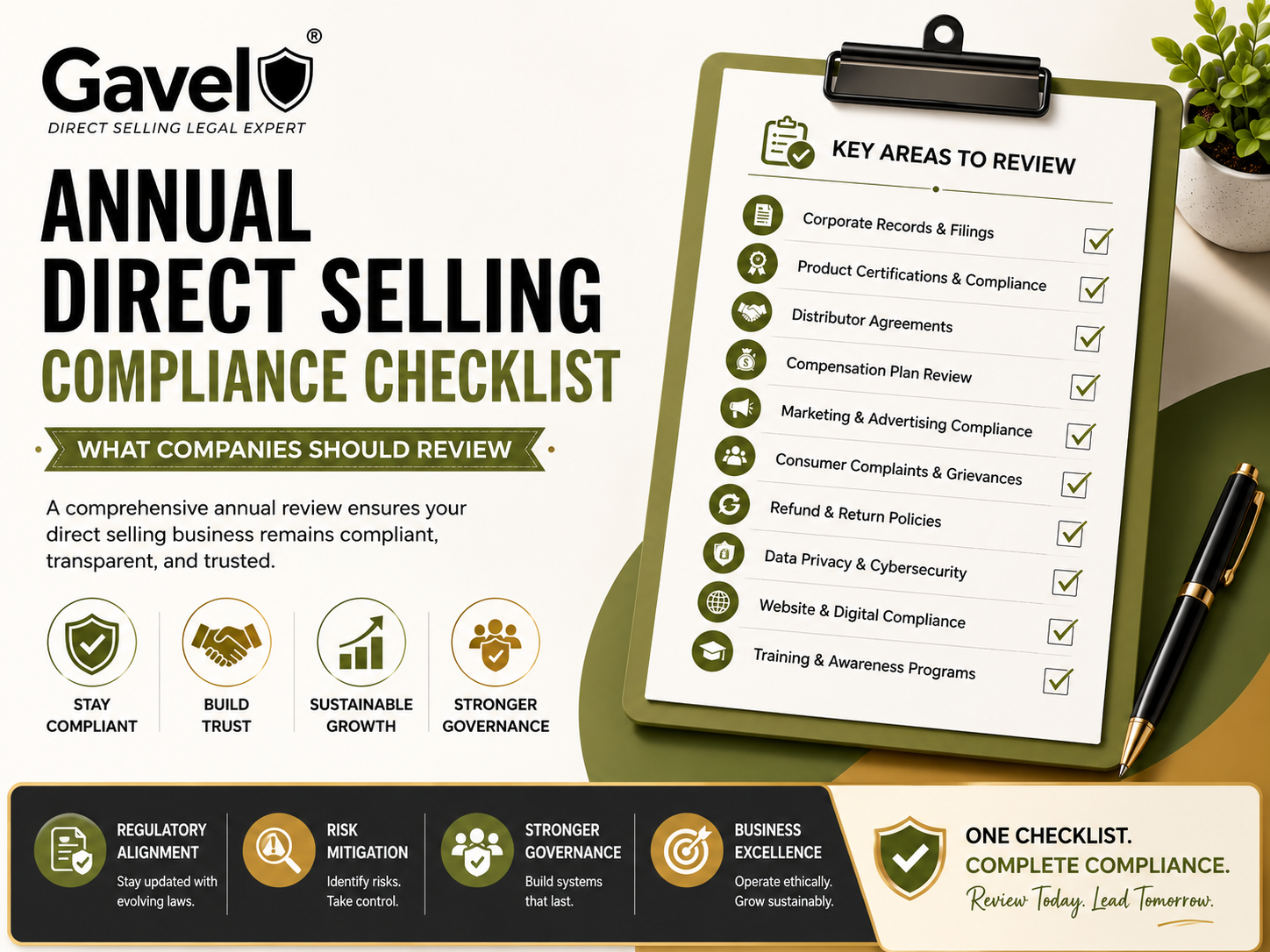
Before launching or scaling an MLM business, review: business structure; business model; compensation plan; distributor agreement; terms and conditions; refund and return policy; grievance mechanism; product compliance; advertising claims; website disclosures; direct-seller records; privacy and data practices; and applicable tax or sector-specific requirements.
How Gavel Law Firm Can Help
Gavel Law Firm provides specialist legal consultancy for Direct Selling and MLM businesses, including MLM compliance, compliance audits, compensation-plan review, legal drafting, regulatory advisory and pyramid-scheme legal defense. The firm positions itself as a dedicated legal consultancy for this sector.


.png)