

Direct Selling Company Registration in India Complete Legal & Compliance Guide
Why Is an MLM Legal Compliance Audit Important in India?
Running an MLM or direct selling business is not only about creating a compensation plan and selling products. A company must also make sure that its business model, documents, products, advertisements, distributor practices, refund system, and consumer protection processes follow applicable Indian laws.
The Consumer Protection (Direct Selling) Rules, 2021 provide an important legal framework for direct selling businesses in India. Companies also need to consider other requirements depending on their products, business structure, online operations, and the states in which they operate. Gavel Law Firm's website also highlights the importance of central and state-level compliance for direct selling businesses.
An MLM Legal Compliance Audit helps identify problems before they become serious legal issues. Instead of waiting for a consumer complaint, government notice, or regulatory investigation, a company can review its operations in advance and correct compliance gaps.
What Is an MLM Legal Compliance Audit?
An MLM Legal Compliance Audit is a structured legal review of an MLM or direct selling company's business operations.
The purpose is simple: find legal risks, identify missing documents, review business practices, and recommend corrective actions.
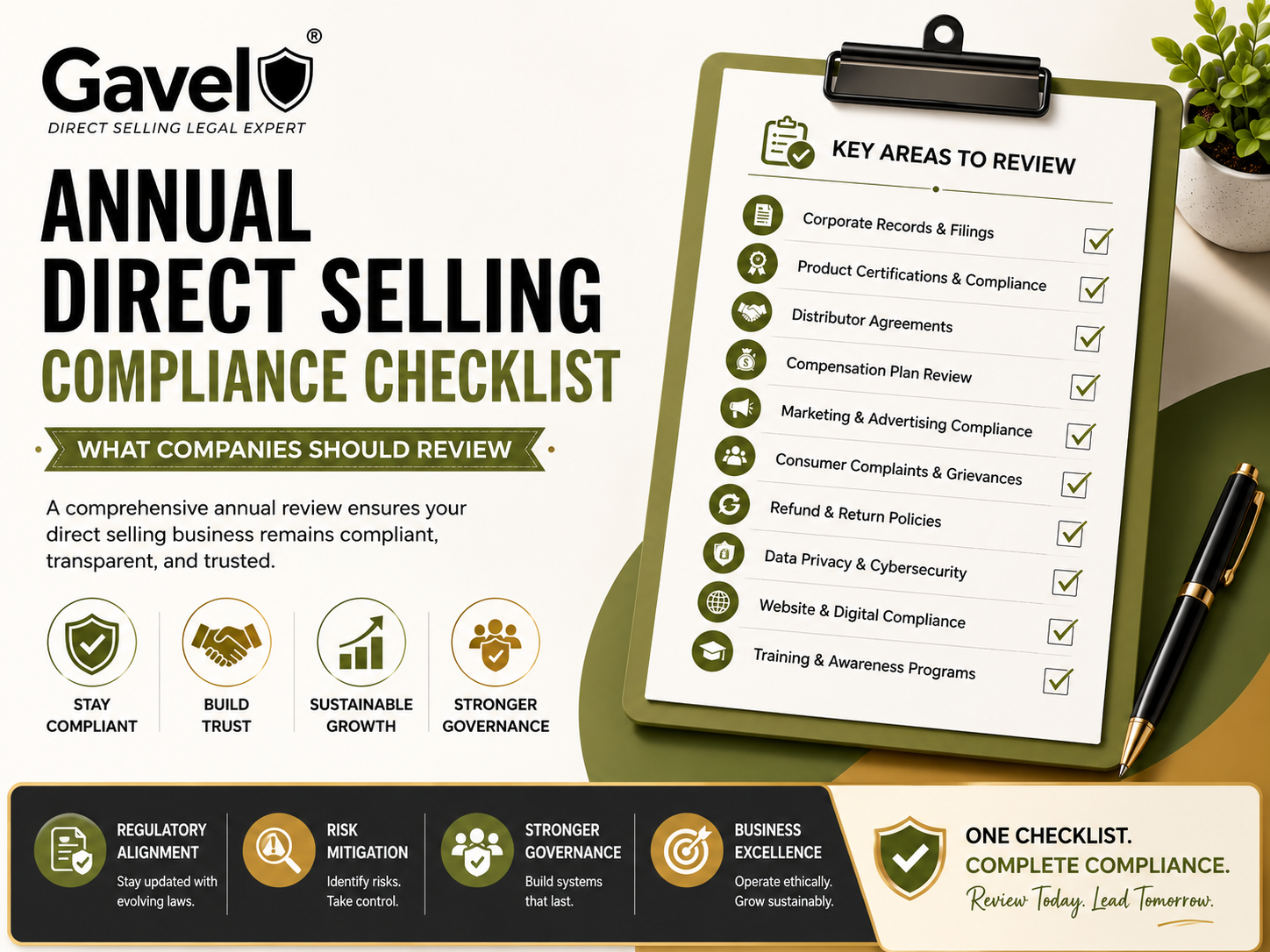
A professional audit may examine:
- Business structure
- Compensation plan
- Distributor agreements
- Company policies
- Product compliance
- Advertising claims
- Income representations
- Refund and return policies
- Grievance redressal system
- Website and e-commerce practices
- Consumer-facing information
- State-level compliance
- Data and privacy practices
This makes a direct selling legal audit useful not only for new companies but also for established MLM businesses.
MLM Legal Compliance Audit Checklist for 2026
1. Review the MLM Business Model
The first step is to understand how the company actually makes money.
A legal review should check whether revenue is primarily connected with genuine product or service sales rather than simply bringing new people into the network.
The company should clearly define:
- What products are being sold
- Who the customers are
- How distributors earn commissions
- How sales are recorded
- How bonuses are calculated
- Whether recruitment affects earnings
A business model that creates strong dependence on recruitment can create serious compliance concerns.
2. Conduct an MLM Compensation Plan Legal Review
The compensation plan is one of the most important areas of an MLM legal audit.
The auditor should examine every commission, bonus, incentive, rank, reward, and qualification condition.
Questions should include:
- Is income connected to actual product sales?
- Are commission calculations transparent?
- Are distributors clearly informed about qualification requirements?
- Are there incentives that indirectly encourage recruitment?
- Are income claims properly supported?
- Is the plan easy for distributors to understand?
Gavel's existing compliance guidance specifically identifies compensation structures as an important area of legal risk for MLM businesses.
3. Check Distributor Agreements and Policies
Every direct selling company should clearly define the relationship between the company and its direct sellers.
The agreement should explain:
- Distributor rights and responsibilities
- Commission rules
- Code of conduct
- Product selling requirements
- Termination conditions
- Refund and return procedures
- Dispute resolution
- Compliance obligations
A company should avoid using copied agreements that were prepared for another business model or another country.
Legal documents should be reviewed according to the company's actual operations in India.
4. Review Product and License Compliance
An MLM company may sell health products, cosmetics, food products, personal care items, lifestyle products, or other goods.
Each category may have different compliance requirements.
Depending on the product, the company may need to review areas such as:
- FSSAI requirements
- AYUSH requirements
- Legal Metrology
- Product labeling
- Trademark protection
- Cosmetic regulations
- Packaging information
- Manufacturing documentation
Product claims should also be checked carefully.
For example, a company should not make unsupported claims that a product can cure a disease or guarantee a particular health result.
Gavel's compliance services specifically cover product-related areas such as FSSAI, AYUSH, Legal Metrology, trademark and cosmetic compliance.
. Audit Advertising and Income Claims
Marketing is another important part of an MLM compliance audit.
Social media posts, websites, brochures, WhatsApp messages, videos, presentations, and distributor-created promotional material can all create legal risks.
Companies should review claims such as:
- “Earn ₹1 lakh every month”
- “Guaranteed income”
- “Become rich quickly”
- “No investment required”
- “Government approved MLM”
- “Guaranteed business success”
Income claims should not create unrealistic expectations.
The company should also have clear rules explaining what distributors can and cannot say while promoting the business.
6. Check Refund, Return and Buyback Policies
Consumer protection is a major part of direct selling compliance.
The company should have clear and accessible policies explaining:
- Product return process
- Refund conditions
- Cancellation process
- Buyback arrangements
- Customer complaint procedure
- Distributor exit process
These policies should be consistent across the company's website, agreements, distributor documents, and actual business practices.
A policy written on paper is not enough if the company does not follow it in practice.
7. Review Grievance Redressal Mechanism
A direct selling company should have an effective system for handling consumer and distributor complaints.
The audit should check whether the company has:
- A clear complaint process
- Responsible personnel
- Complaint records
- Response timelines
- Escalation procedures
- Proper communication channels
Gavel's existing compliance guidance identifies grievance redressal and consumer protection as important compliance areas for MLM and direct selling companies.
7. Review State-Level Compliance
Direct selling companies operating across India should not look only at central requirements.
Gavel's website currently lists various state-level direct selling frameworks, including mechanisms and guidelines for states such as Kerala, Meghalaya, Haryana, Rajasthan, Telangana and others.
Therefore, companies operating in multiple states should identify whether additional state-level requirements apply to their activities.
This is especially important for businesses expanding rapidly across India.
8. Prepare a Corrective Action Plan
An audit should not end with simply identifying mistakes.
The company should receive a practical action plan showing:
High-risk issues → Immediate correction
Medium-risk issues → Correct within a defined timeline
Low-risk issues → Improve during routine compliance updates
This approach helps management understand what needs to be fixed first.
Regular audits can also help businesses identify new risks when they introduce new products, change their compensation plan, expand into new states, or modify their online operations.
When Should an MLM Company Conduct a Legal Compliance Audit?
A company should consider an MLM legal audit:
- Before launching its MLM business
- Before changing its compensation plan
- Before launching new products
- Before entering new states
- After receiving consumer complaints
- Before major business expansion
- After changing distributor policies
- When updating its website or software
- Periodically as part of compliance management
Conducting an audit before a problem becomes serious is generally more practical than trying to fix everything after receiving a legal notice.
Benefits of an MLM Compliance Audit
A proper MLM compliance audit can help a company:
- Identify legal risks early
- Improve business documentation
- Strengthen consumer protection
- Reduce regulatory exposure
- Improve distributor transparency
- Review compensation structures
- Protect brand reputation
- Improve internal compliance systems
- Support sustainable business growth
Compliance is not simply a legal formality. It can become an important part of building trust with customers, distributors, business partners, and investors.
How Gavel Law Firm Can Help With MLM Legal Compliance
An experienced legal team can review different parts of an MLM business together instead of examining only one document.
Gavel Law Firm provides legal and compliance support specifically for Direct Selling and MLM businesses. Its services include MLM legal compliance, legal audits, compensation plan review, documentation, product compliance, state-level compliance, and regulatory advisory.
The firm states that it has assisted 400+ direct selling companies and has 33+ legal professionals, with pan-India support.
For an existing company, a legal audit can help identify gaps. For a new business, compliance review can help create a stronger legal foundation before operations begin.
Conclusion
An MLM Legal Compliance Audit in India is an important step for companies that want to operate responsibly and reduce legal risks. A proper review should cover the business model, compensation plan, distributor agreements, product compliance, advertising, consumer protection, refunds, grievance redressal, website practices, and state-level requirements.
The goal of an audit is not simply to find mistakes. It is to help the company correct those mistakes and build a more transparent and sustainable business.
As the Indian direct selling sector continues to develop, companies should treat compliance as an ongoing process rather than a one-time activity. Regular legal reviews can help businesses stay prepared as their products, distributors, technology, and operations grow.
For professional guidance on MLM compliance audit, direct selling legal audit, compensation plan review, and regulatory compliance, businesses can consult Gavel Law Firm, a specialized legal firm focused on Direct Selling and MLM businesses in India.


.png)