
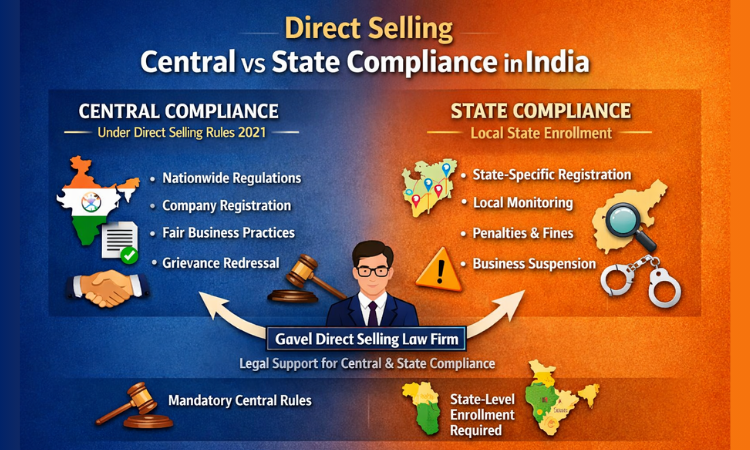
Direct Selling Central vs State Compliance in India
State-Level Direct Selling Monitoring Mechanisms in India
(A Complete Guide for Every Direct Selling Company Operating in India)
Introduction
The direct selling sector in India has grown rapidly over the last decade, and with this growth comes the responsibility to regulate business practices, protect consumers, and eliminate fraudulent pyramid-style schemes. Under the Consumer Protection (Direct Selling) Rules, 2021, every direct selling company operating in India must comply with central rules as well as state-level monitoring mechanisms wherever applicable.
Today, multiple states in India have notified their own Direct Selling Monitoring Mechanisms to oversee the activities of direct selling companies, ensure transparency, maintain compliance, and safeguard consumers.
This blog provides a detailed overview of state-level monitoring frameworks already notified in India and explains what every direct selling company needs to do to stay compliant.
List of Indian States with Direct Selling Monitoring Mechanisms
(States as per list available on Gavel Law Firm’s official website)
States that have notified monitoring committees or mechanisms include:
-
Tamil Nadu
-
West Bengal
-
Mizoram
-
Haryana
-
Rajasthan
-
Nagaland
These states have formally issued guidelines or notifications that directly affect how a direct selling company operates within their borders.
Why State-Level Monitoring Mechanisms Are Important
The central DS Rules 2021 mandate that every state should:
-
Create a monitoring committee
-
Appoint a nodal department
-
Appoint a nodal officer
-
Supervise and regulate every direct selling company
-
Prevent pyramid or money-circulation schemes
-
Protect consumers and genuine direct sellers
This structure ensures that a direct selling company is not only compliant at the national level but also follows local regulatory obligations.
The objective is simple:
To promote fair business practices and remove fraudulent elements misusing the label of a “direct selling company.”
State-Wise Overview of Monitoring Mechanisms
Below is a detailed overview of each state’s regulatory preparedness and how it impacts a direct selling company operating in that region.
1. Andhra Pradesh
Andhra Pradesh has officially notified the “Direct Selling Guidelines, 2022.”
A nodal department and nodal officer have been appointed for administration.
Every direct selling company operating in Andhra Pradesh must submit declarations, follow consumer protection guidelines, implement grievance redressal, and maintain transparent business operations.
2. Kerala
Kerala was one of the first states to implement a detailed monitoring mechanism exclusively for direct selling companies.
The mechanism includes:
-
State-level monitoring committee
-
Multiple departments (consumer affairs, food & civil supplies, taxation, GST, police)
-
Reporting and oversight obligations
A direct selling company working in Kerala must submit compliance declarations as required by the state.
3. Maharashtra
Maharashtra has set up a Direct Selling Monitoring Committee to ensure that every direct selling company follows DS Rules 2021 and state-specific compliance requirements.
This helps maintain strict oversight and ensures that no fraudulent direct selling model harms consumers.
4. Meghalaya
Meghalaya has also notified guidelines for regulating direct selling activities.
A direct selling company operating here must follow central rules and adhere to the state’s supervision protocols.
5. Tamil Nadu
Tamil Nadu has officially released Direct Selling Guidelines and monitors the compliance of direct selling companies statewide.
Companies must maintain clear policies, proper agreements, and grievance mechanisms.
6. West Bengal
West Bengal has notified its own monitoring mechanism to regulate any direct selling company operating within the state.
Companies must ensure transparency in earnings, clear distinction between product sales and incentives, and compliance with refund and return policies.
7. Mizoram
Mizoram has introduced a Direct Selling Monitoring Authority to govern direct selling activities.
The state requires a direct selling company to comply with operational guidelines and submit required documentation.
8. Haryana
Haryana has listed its monitoring mechanism for regulating direct selling companies.
Compliance with state-level supervision is mandatory for any company functioning in Haryana.
9. Rajasthan
Rajasthan has also listed its Direct Selling Monitoring Framework.
A direct selling company operating in Rajasthan must align with both central rules and state-specific compliance obligations.
10. Nagaland
Nagaland’s monitoring mechanism includes oversight responsibilities for regulating any direct selling company in the state.
Companies must maintain transparent practices and proper consumer protection systems.
What a Direct Selling Company Must Do in These States
Regardless of the state, every direct selling company should:
✔ Submit required declarations
✔ Provide proper agreements to direct sellers
✔ Maintain return, refund, and buy-back policies
✔ Ensure GST, tax, and operational compliance
✔ Avoid misleading income claims
✔ Maintain strong grievance redressal
✔ Separate sales incentives from recruitment incentives
✔ Never promote pyramid-type schemes
A compliant direct selling company must work in line with both Central DS Rules 2021 and the respective state’s monitoring mechanism.
Why These Mechanisms Matter to the Direct Selling Industry
-
Prevents fraud
-
Many illegitimate schemes misuse the title “direct selling company.”
-
State-level checks help filter genuine companies from frauds.
-
-
Protects consumers
-
Ensures product quality, refunds, transparency, and fair pricing.
-
-
Protects genuine direct sellers
-
Helps safeguard distributors from illegal business practices.
-
-
Encourages ethical business
-
Encourages every direct selling company to operate responsibly.
-
-
Builds trust in the industry
-
More compliance = more trust = more long-term growth.
-
Growth Opportunities for a Compliant Direct Selling Company
A legally compliant direct selling company gains:
-
Higher credibility
-
Better investor trust
-
Improved distributor satisfaction
-
Faster approvals in new states
-
Long-term sustainability
The future of direct selling in India is strong — but only for those direct selling companies that operate legally and ethically.
Conclusion
State-Level Direct Selling Monitoring Mechanisms are now a crucial part of India’s regulatory structure.
Any direct selling company planning to expand across India must understand each state’s guidelines along with central rules.
A compliant direct selling company not only avoids legal trouble but also builds trust and long-term business stability.
Whether you are launching a new direct selling company or already running one, understanding state-level mechanisms is essential for smooth operations and sustainable growth.

.png)