
Direct Selling Company Registration in India Complete Legal & Compliance Guide
What Is Direct Selling? A Complete & Practical Guide
Understanding Direct Selling in Simple Words
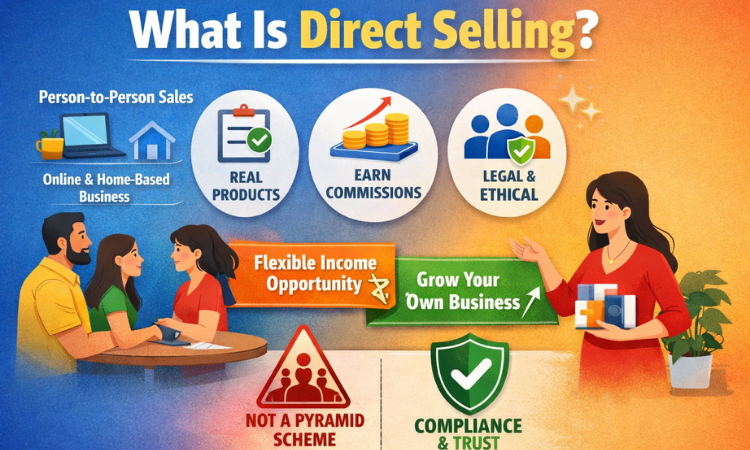
Direct selling is a business model where products are sold directly to consumers without retail stores. The sale happens through people, not shelves. A direct seller personally explains, demonstrates, and recommends products, building trust and long-term customer relationships. This human connection is the backbone of direct selling.
Why Direct Selling Exists Even in the Digital Age
Despite e-commerce growth, people still value personal guidance and trust—especially for wellness, beauty, nutrition, fashion, and lifestyle products. Direct selling fills this gap by combining personal interaction with modern digital tools like WhatsApp, video calls, and social media.
How the Direct Selling Business Model Works
A direct selling company manufactures or sources products and appoints independent sellers. These sellers earn commissions on product sales. Some models also allow sellers to build teams, but income must always be linked to actual product sales, not mere recruitment. This is the critical line between legal direct selling and illegal schemes.
Types of Direct Selling Models
Direct selling operates through single-level selling, multi-level structures, party-plan selling, and online social selling. Each model has one common rule: real products must reach real customers. When product value disappears, the model collapses legally and commercially.
Why People Choose Direct Selling as a Career or Side Income
Low entry barriers, flexible working hours, and the ability to scale income through effort make direct selling attractive. Students, homemakers, professionals, and retirees use it as a primary or secondary income source. Success, however, depends on consistency, product belief, and ethical selling.
Benefits for Consumers
Consumers receive personalized product explanations, demonstrations, after-sale support, and easy returns. Unlike retail, direct selling focuses on long-term customer satisfaction, not one-time transactions. This creates loyalty and repeat business.
Growth of Direct Selling in India
India has become a major hub for direct selling due to its entrepreneurial population, digital penetration, and growing demand for wellness and lifestyle products. Both Indian and global companies operate across states, making compliance and transparency more important than ever.
Common Myths About Direct Selling
Many people confuse direct selling with fraud or pyramid schemes. The truth is simple: if income depends on selling products, it is direct selling; if income depends mainly on recruitment fees, it is illegal. Awareness and education are key to removing this confusion.
Legal & Compliance Importance in Direct Selling
Direct selling is a regulated activity. Companies must follow prescribed rules, maintain proper agreements, define commission structures clearly, and protect consumer rights. Ignoring compliance can lead to investigations, penalties, and business shutdowns.
The Future of Direct Selling
The future belongs to transparent, tech-enabled, compliance-driven direct selling companies. Brands that respect consumers, empower sellers, and operate legally will grow sustainably. Direct selling is no longer informal selling—it is a structured, accountable business model.
-
What is direct selling
-
Direct selling meaning
-
Direct selling meaning in Hindi
-
Direct selling vs MLM
-
Is direct selling legal in India
-
How direct selling works
-
Direct selling business plan
-
Direct selling companies in India
-
How to start direct selling business
-
Direct selling income system
-
Direct selling commission structure
-
Direct selling rules in India
-
Direct selling registration process
-
Direct selling agreement format
-
Direct selling refund policy
-
Direct selling compliance checklist
-
Direct selling vs pyramid scheme
-
Best direct selling products
-
Direct selling business model
-
Direct selling training ideas
-
Direct selling marketing strategy
-
Direct selling lead generation
-
Direct selling success tips
-
Direct selling legal risks
-
Direct selling tax on commission
-
Direct selling company setup India
-
Direct selling distributor rights
-
Direct selling seller responsibilities
-
Direct selling customer complaints
-
Direct selling monitoring mechanism
-
Direct selling ethics
-
Direct selling advertising rules
-
Direct selling online selling
-
Direct selling social media rules
-
Direct selling KYC requirements
-
Direct selling termination policy
-
Direct selling grievance redressal
-
Direct selling compliance audit
-
Direct selling product pricing rules
-
Direct selling consumer protection
-
Direct selling business growth tips
-
Direct selling onboarding process
-
Direct selling documentation
-
Direct selling policy drafting
-
Direct selling operations model
-
Direct selling legal framework
-
Direct selling business challenges
-
Direct selling opportunities in India
-
Direct selling career scope
-
Direct selling industry future
Gavel Direct Selling Law Firm
Direct selling can grow fast—but only when it grows legally and responsibly.
From company formation to compliance frameworks, seller agreements, policies, and regulatory risk management, Gavel Direct Selling Law Firm focuses exclusively on protecting and strengthening direct selling businesses in India.
If you are planning, running, or scaling a direct selling company—connect with Gavel Direct Selling Law Firm and build your business on a legally strong foundation.



.png)